Residency Permits in Curaçao for Canadians
In order to relocate to Curacao, you need to have a permit. Even wintering requires special permission because the max number of days you can stay without it is 90 days. We are lobbying the government to extend this to 180 days, but so far, this has not passed.
There are several options:
- Residency Permit
- Investor’s Permit
- Pensioner’s Permit
- Digital Nomad Permit
- Work permit; must have an employer to sponsor you and initiate the application.
- Hibernator Visa: “extend” vacation to 180 days
The process can take 3-4 months (or more), and you must have valid Health Insurance (Local or International…your Canadian Provincial Health Card is not sufficient).
Navigating these processes can be cumbersome, confusing and frustrating, so we have created this page to try and help a bit.
The Most Important Part…Choosing your Immigration Expert:
I know a few people who have managed this epic undertaking without the help of a local expert. Those people seem to be a combo of genius and insane!! I give them full props; there is no way I could have done it…not a chance.
We highly recommend that you engage an Immigration Expert. They know the system, the people, the processes, the language, and they are here, so can handle any issues that arise easily and quickly. Trying to put out fires from Canada would be horrible.
There is one company that is known as one of the most established immigration firms in Curaçao. When we contacted them, they did not seem particularly interested, responsive or helpful. I assume once we had engaged them, this would have improved, but I was not impressed. They honestly did not seem interested in dealing with the process a Canadian would have to go through. People from the Netherlands or the US have a much easier time, and the processes are much more established for them. I get the impression that this company was only interested in dealing with people from those two countries.
A little research brought me to Living in Paradise. I emailed and received an immediate reply from Monica Saavedra, the owner. We set up a video chat, and my wife and I were soon speaking to Monica live, and getting thorough answers to our 9 billion questions. It became apparent that Monica’s focus was full customer support, and that she really wanted to help those of us from countries other than the US and the Netherlands. The website is easy to navigate and contains TONS of amazing info and blog posts that help explain some of the complexities of obtaining residency permits in Curaçao. This initial meeting and the abundant info on the website had us sold. We decided to go with Monica, and are we ever happy we did!!! I can’t recommend this company strongly enough…worth every penny!!
Next Step…the Documents!!

In order to apply for residency (the Immigration Expert will be able to determine the best residency permit options for you), Curaçao requires that you submit the following documents:
- A copy of each applicant’s passport
- Birth certificate (long form, not just the card) with apostille for each applicant (issued no more than 1 year ago)
- Criminal record (the one with the fingerprints) for each applicant over 18 years old (issued no more than 3 months ago)
- Marriage certificate with apostille (issued no more than 1 year ago)
- An original bank letter stating that the applicant has sufficient monetary resources to support themselves and their family. For a minimum of 2 people, $25,000 is required (amount available equivalent in dollars).
Key points:
You will likely need to request new originals for of birth certificates and marriage certificates due to the time frames noted. We had to get them all re-issued. Make sure you get the correct versions. Each needs to be the LONG FORMS. These are the actual signed copies created at the time of the birth or marriage. Learn from my mistake; I got the short form of two of these and then had to get new ones issued. Also, for those in Quebec or Ontario, your documents must be translated to English by an official translator. Learn from my mistake: I originally submitted my wife’s birth certificate in French and had to go through the whole process below twice for her stuff!! Ugh. I tried to convince Curaçao that it was “Canadian, not French,” but they wouldn’t go for it!!
You probably note the word “apostille.” In 1961, a bunch of countries got together and created a process by which documents created in one country can be considered legal in another country. Over 100 countries signed on to this, but Canada wasn’t one of them. (Thanks for nothing, Diefenbaker, you crumb!!) This means that we Canadians must go through a different process.
First, you have to get each document “authenticated” by a government agency. Each province may have a different process. In Ontario, you have to take your original documents to Official Documents Services, 222 Jarvis Street, Toronto. Once authenticated, your document will be attached to a cover page which notes that it is authentic. I, of course, had to add an extra wrinkle. I was born in Manitoba, so I had to have my birth certificate notarized, then get the notarized copy authenticated. The other option would have been to do my stuff in Manitoba. Other than visiting family and friends, there are few things that could get me back in Manitoba, and this wasn’t one of those things!!

Next, you have to take your authenticated documents to the Dutch Consulate or Embassy where they will “legalize” the document. The Consulate in Toronto is at #1 Dundas St W, Toronto, so you can do authentication and legalizing in one day. When they legalize it, they will place a small label and stamp on the back of the authentication cover page which notes it has been legalized by the Netherlands.
In short “authenticated” and “legalized” documents = “apostilled”.
If you live in Ontario, it may be possible for you to simply go to Toronto and do all this yourself. For me, it was 10 hours of driving, which I did twice, because…see above…lol. You can also do all this by mail. The idea of trusting Canada Post with all these documents that I nearly had an aneurysm gathering was simply not palatable. You can also have this all done for you by Global Affairs Canada, but that would have taken several weeks and we did not have the time.
So: Notarize (if needed), then Authenticate, then Legalize
Now the good news!!!
On May 12, 2023, Canada FINALLY signed on to the Hague Convention (62 years late) and as of January 11, 2024, apostille is available across Canada (as far as I know, this must be done my mail or in person). Congrats to all of you who won’t have to jump as many hurdles going forward!! You will now just get your documents, have them apostilled, and then submit to your immigration specialist!!
For details on Apostille in Canada, beginning January 2024, click here. And for more info from our Government on specifics for your region in Canada, click here.
That was the hard part… Living in Paradise does the rest!!!
Once we got all our documents to Monica, she submitted our applications for us. She kept us apprised of the progress with periodic updates. First, she sent us our “proof of application.” Then, we got a few updates informing us of how many weeks the process was taking during that period. Finally, we got our “approval” email.
Monica then made our appointments (see below) and even helped us get our health insurance. If you check through her website, you’ll see there are many other services offered that could be very useful depending on your specific circumstances.
Our next step was to go to Immigration and get our Permits. Monica met with us ahead of time to help organise our documents. She took all our original documents with her, and met us at the Immigration office with them to make sure everything went smoothly. Because she is well known in these circles and speaks Papiamentu, it was more helpful than I imagined. We were in and out in an hour.
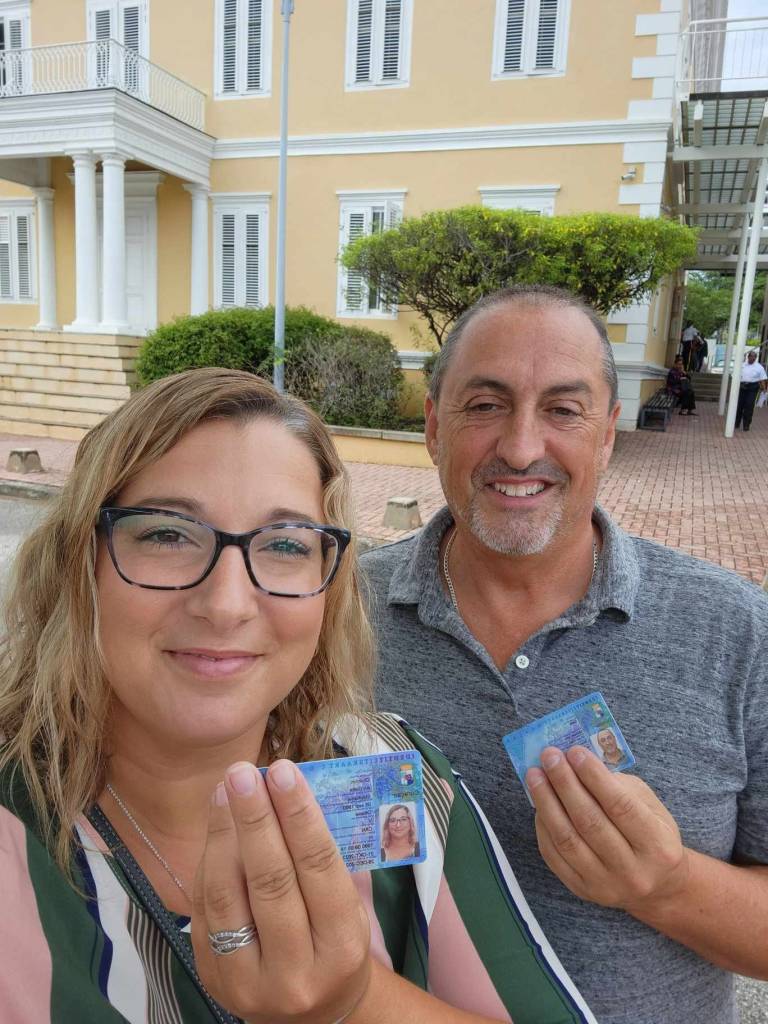
Then it was off to Kranshi (the Civil Registry). There, we showed our residency permits in order to apply for a local ID card called the Sedula. Again, Monica accompanied us to ensure everything was perfect. Three days later, we went back to obtain our Sedula and our BB10 form (the form you need if you are importing your household belongings, etc.). Monica arranged all these appointments for us…again, super helpful!!
Note: You will also have to pay a deposit of 2000NAF per person, which you will get back if you decide to move back home.
Summary:
All in all, this process nearly killed me. I gained 30 pounds and developed high blood pressure (which has now come back down). On the bright side, it gave me the motivation needed to finish all the booze in the liquor cabinet that I couldn’t bring to Curaçao anyways. And it was worth it!! We’re here now, and that’s the important part.
People often ask why they have to make it all so unnecessarily complex. The answer is clear. If it was easy, everyone would be here. We don’t have room for everyone!! So, consider all this the “skill testing question.” The best things are worth working for.
The best piece of advice I can give is to engage an immigration expert. We simply would not have made it without the patience, expertise, knowledge, energy and humor of Monica and her amazing company, Living in Paradise.
If you have any questions about any of this, feel to ask through our Contact Us form.
See you on the Beach!!
 Curaçao 4 Canadians
You must be logged in to post a comment.